What is kanban?
How a kanban board works, how to set one up and how to keep it up to date with your team.
What is a Kanban board?
A Kanban board is a board with columns on which a team makes its work visible. Each card is one piece of work. The card moves from left to right: from what is waiting, through what is in progress, to what is done. That way everyone sees at a glance where the work stands, who is working on what and what is being left.
The word kanban comes from Japanese and means something like card or board. The idea is simple: make the work visible, do not take on too much at once, and finish before you start something new.
Cards, columns and a name
A card describes what needs to happen, in a few words: "November payslips", "Letter to parents about the school trip". Each card shows who does it and, where needed, when it has to be done. The columns are the steps the work goes through. Where a card is tells you how it is going.
A team board
A Kanban board for a team is also called a team board. It is there for the conversation, not to report upwards. A team that looks at the same board together needs to ask less about how things are going, and has more time for what really matters.
Setting up a Kanban board in five steps
1. Put the work that is there now on cards
Do not start with an empty board and a plan, but with the work that already exists. Go through what everyone is working on and what is still waiting. Each thing becomes a card.
2. Choose your columns
Start with To do, Doing and Done: what still needs doing, what is in progress and what is done. Only add more when the work asks for it. If work often waits on someone else, such as a client or an approval, add a column Waiting for between Doing and Done.
3. Put a name on every card
A card without a name gets left. One name per card: who makes sure it gets done. That does not mean that person does everything alone.
4. Agree a limit for Doing
How many cards can be in Doing at the same time? Choose a number that suits the team, and stick to it. More on that below.
5. Choose a fixed moment to stand at the board together
A board nobody looks at together falls behind within a week. Agree a fixed meeting, every week or more often, and always start that meeting at the board.
Which columns do you put on a Kanban board?
At least: what still needs doing, what is in progress and what is done. Then add what your work needs. The fewer columns, the sooner you see where things are stuck.
Examples per type of team
- An accounting firm: Backlog, To do, Doing, Waiting for and Done. Waiting for holds the documents a client still has to send.
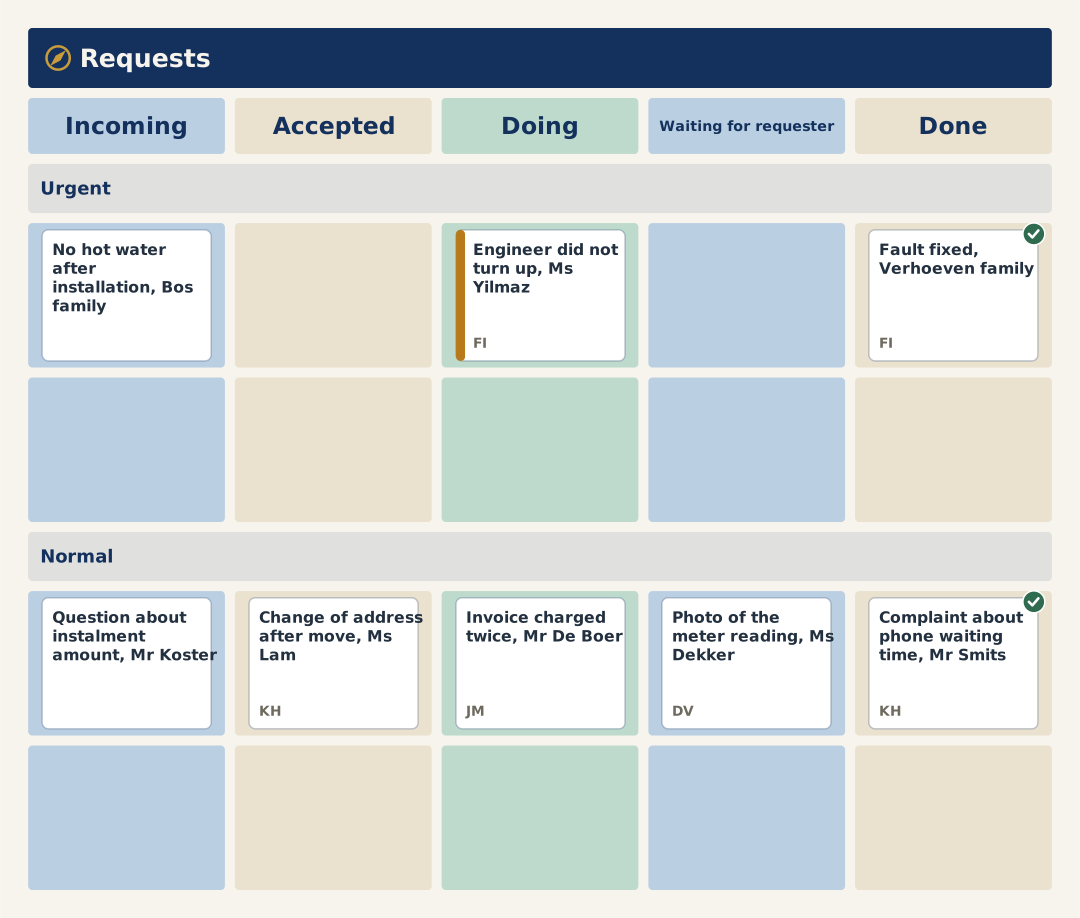
- A customer service team: Received, Accepted, Doing, Waiting for requester and Done, with lanes for urgent and normal.
- A school team using a board for its team meeting: Raised, Discussed, Actions, Parked and Completed. Here a card is not a task but a topic.
- A care team with an improvement board: Ideas, Chosen, Trying out, Does it work?, Adopted and Stopped.
- A construction project team: an ordinary work board, with one lane per track: technical, processes, people and communication.
Lanes (swimlanes)
A lane is a row across the whole board. It separates kinds of work without extra columns: urgent and normal, or the tracks of a project. Use them sparingly. Two or three lanes make a board clearer, ten lanes do not.
How many cards at once? The limit per column
Whoever starts too much at once finishes less. That is true for a person and for a team. A limit per column shows when it happens. When Doing is full, the team first finishes something before starting something new.
How do you choose the number?
Start with roughly the number of people in the team, or a little less. Look again after a few weeks: if Doing is always full and everything gets stuck, the number is too high. If there is never enough in it, it is too low. The number is an agreement of the team, not a rule from outside.
What if Doing is full?
Then the question is not "who still has room?" but "what can we finish together?". Often something is almost done and waiting on one thing. Helping there achieves more than starting something new.
The meeting at the board
A Kanban board shows what is waiting. What the team does with it happens in the meeting. A board without a fixed meeting becomes a list nobody keeps up. A meeting without a board becomes a round in which everyone says what they are doing.
An agenda that follows the board
Start with what needs attention: what is stuck, overdue, unassigned or showing no recent progress. Then go through the board from right to left: first what is almost done, then what is in progress, and only at the end what is new. Finish with what will be picked up next.
Decisions and actions on the card
What is decided in the meeting belongs with the card it is about. An action becomes a new card with a name and a date. That way the agreement is where the team sees it again tomorrow, not only in the minutes.
How often?
Most teams meet at the board every week. Teams whose work shifts from day to day also hold a short daily stand-up. For a meeting where people raise topics, a board of its own works well: see team meeting.
Common mistakes with a Kanban board
Too many columns
Every step in the work gets its own column. The board gets wide, cards hardly move and nobody sees where things are stuck. Start small and only add when needed.
Too much at once
Everything is in Doing. Everyone is busy, but little gets finished. A limit makes that visible.
Cards without an owner
What belongs to everyone belongs to no one. Put a name on every card.
A board that is not right
Cards sit in Doing while nothing has happened for weeks. Whoever does not trust the board stops looking at it. Agree that whoever picks something up or finishes it moves the card straight away.
No fixed moment
The board is there, but the team never stands at it together. Then it becomes a notice board.
Keeping a Kanban board up to date
By working with it together. Whoever picks something up moves the card. Whoever finishes puts it in Done. In the meeting you first discuss what is stuck, overdue or showing no recent progress.
Tidy up regularly. Cards that have been in the backlog for months and that nobody will do can go. A board about today reads better than an archive.
And now and then look at the board itself. Does the layout still match the work? A column that is always empty can go. A column where everything gets stuck deserves a conversation.
A Kanban board on the wall or online?
On the wall you only see the board when you stand in front of it. That works for a team that is in the same place every day. If part of the team works from home or another location, they do not see the board, and it soon falls behind.
Online the whole team sees the same board, including whoever works from home or elsewhere. And what is agreed in the meeting is on the card straight away. Nothing needs to be typed up.
Kanban and Obeya
A Kanban board shows what the team is doing now. An Obeya shows what the team is doing it for: where it wants to go, which goals belong to that and whether it is on track. That is why a Kanban board often sits under an Obeya. With Kanban you start yourself, for one team. What is an Obeya?
The difference with a separate board
On a separate board you see what is waiting. With the meeting built in, the team also knows what was agreed.
What does your meeting cost per year?
Select the number of people attending and how many minutes the meeting usually runs over.
That's 260 hours a year—for just one recurring meeting.
For example: 10 people × 30 extra minutes × 52 weekly meetings = 260 staff hours a year.
Questions about Kanban
What is a Kanban board?
A board with columns on which a team makes its work visible. Each card is one piece of work. It moves from left to right: from what is waiting, through what is in progress, to what is done. That way everyone sees at a glance where the work stands.
How do you set up a Kanban board for your team?
Start with three columns: To do, Doing and Done. Put the work that is there now on cards, each with the name of who does it. Agree when you stand at the board together. At Midflyt you choose a way of working; the columns and the agenda of the meeting are then ready.
Which columns do you put on a Kanban board?
At least: what still needs doing, what is in progress and what is done. Then add what your work needs, for example a column for work that is waiting on someone else. The fewer columns, the sooner you see where things are stuck.
Why put a limit on the number of cards in a column?
Whoever starts too much at once finishes less. A limit per column shows when that happens. Then the team chooses to finish something before starting something new.
What is the difference between a Kanban board on the wall and an online Kanban board?
On the wall you only see the board when you stand in front of it. Online the whole team sees the same board, including whoever works from home or elsewhere. And what is agreed in the meeting is on the card straight away.
How do you keep a Kanban board up to date?
By working with it together. Whoever picks something up moves the card. In the meeting you first discuss what is stuck, overdue or showing no recent progress. A board nobody uses falls behind within a week.
What is a team board?
A board on which a team sees what is going on: who is working on what, what is left lying and what is done. The board is there for the conversation, not to report upwards.
What do you put on a team board?
The work the team is doing now, with on each card who does it. What is waiting on someone else gets its own column. Do not put more on it than the team can discuss in the meeting.
What is the difference between Obeya and Kanban?
A Kanban board shows what the team is doing now: what is waiting, what is in progress and what is done. An Obeya shows what the team is doing it for: where it wants to go, which goals belong to that and whether it is on track. Kanban keeps the work moving. Obeya helps choose which work matters. That is why a Kanban board often sits under an Obeya. With Kanban you start yourself, for one team. Obeya starts with a training, because it asks a team to look, choose and agree differently.