Team meeting: the board is the agenda
What someone raises is discussed and ends in a decision or an action.
Does this sound familiar?
What is a team meeting, and what is it for?
A team meeting is the regular moment when a team looks at its work together. Not to tell each other what everyone has done, but to decide what is needed: what is stuck, what do we pick up, and who does what.
A good team meeting produces something you can point to afterwards: a decision, an action with a name attached, or a topic that is deliberately carried over to next time. A meeting that produces none of these feels like wasted time. And it is.
The purpose of a team meeting
- Agreeing on work that concerns the whole team.
- Discussing what is stuck and cannot be solved by one person.
- Checking whether what was agreed last time has been done.
- Discussing topics that colleagues have raised.
Team meeting or staff meeting?
Team meeting and staff meeting are two names for the same thing: the regular meeting in which a team looks at its work together. Some organisations use one name, others the other. What counts is not the name but what comes out of it: decisions, actions with a name attached and topics that are deliberately carried over to next time.
What a team meeting is not
Not a round of announcements: anything that could go in an email does not belong on the agenda. And not a handover. The handover between shifts in healthcare, the briefing before a shift in hospitality or the agreements on a building site are about today. That is what a short daily stand-up is for. The team meeting looks further ahead: what is stuck, what keeps coming back, and what does the team need to decide together?
A check-in to start
Start the team meeting with a short check-in: how is everyone doing? Then everyone has said something straight away, which makes it easier to raise something later.
A team meeting agenda: an example
The best agenda is the same every time. Then nobody has to draw it up, and everyone knows what is coming.
1. Check-in
Briefly: how is everyone doing, and is there anything that will affect today's meeting?
2. Decisions and actions from last time
Go through the actions agreed last time. Have they been done? If not, what is needed? This item is the difference between a meeting where agreements are forgotten and a meeting where they are carried out. People who know the question is coming are more likely to do it.
3. The topics the team has raised
Take them one at a time. Every topic ends in one of three ways: a decision, an action with a name and a date, or next time. Agree on this out loud before moving on to the next item.
4. Wrap up
What have we decided, and who does what? Who sends out the meeting report?
An example from education
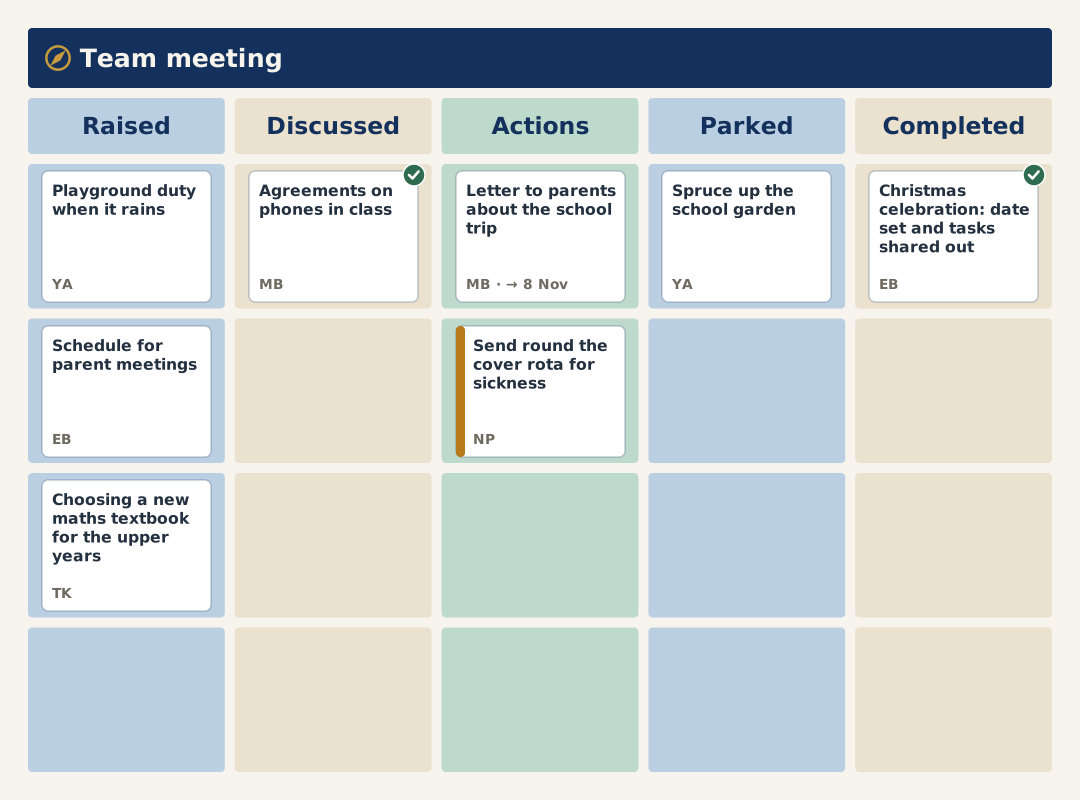
The team at a primary school has raised three topics this week: playground duty when it rains, the schedule for parent meetings and choosing a new maths textbook. Last time, two actions were agreed: a letter to parents about the school trip, and sending round the cover rota for sickness. The meeting starts with those two actions. The letter has gone out. The cover rota has not: something else is needed for that, and it becomes a new agreement.
Preparing a team meeting
A good team meeting starts before anyone sits down. Whoever prepares it prevents the meeting from getting stuck on a topic nobody can decide on, or on information that is not available.
How to prepare a team meeting
- Look at the actions from last time. What has been done, and what has not? That is what the first agenda item is about.
- Look at what has been raised. Is every topic clear? What is the person who raised it asking of the team: input, a decision, or simply to be informed?
- Choose the format for each topic. Informing, gathering views or deciding. If the team does not know which, every topic turns into a discussion.
- Make sure the information is available. Not by preparing it yourself, but by checking in good time that it will be ready.
- Check who needs to be there. If a decision is needed, the person who can take that decision needs to be there too.
A fixed agenda format
Use the same format every time: check-in, decisions and actions from last time, the topics raised, wrap up. Then nobody has to come up with the agenda again. On a Kanban board for the meeting, the agenda is ready automatically: whatever is in Raised is on the agenda for the next meeting.
An example from construction
At an installation company, the work planner prepares the team meeting. The topics raised are the delivery time for a part and a question about the new job sheets. A decision is needed on the delivery time, so the project manager needs to be there. The job sheets are for information only: that can be brief.
Raising topics: how everything gets onto the agenda
In many teams, items for the meeting come in via the corridor, email and the group chat. The chair collects them, or forgets a few. Whoever raises an item does not know whether it will ever be discussed.
It works better if everyone puts their own topic in one place the whole team can see. On a meeting board, that is a Raised column: each topic is a card with the name of the person who raised it. Whatever is there is the agenda.
What makes a well-raised topic
A topic that concerns the team and that the team can decide on. Write it so that everyone understands what it is about: not "schedule" but "schedule for parent meetings". Whoever raises it says at the start what they are asking of the team: input, a decision, or simply to be informed.
What does not belong in a team meeting
Announcements that could go in an email. A topic that only concerns two people. And discussions that have already been held three times without an outcome: those first need someone to prepare them.
How long and how often should you hold a team meeting?
Most teams meet once a week or once every two weeks. More important than how often is that the meeting takes place at a fixed time. Then everyone plans around it, and it does not keep getting moved when things are busy.
Keep it as short as possible. Agree an end time and stick to it. Whatever does not fit goes to next time. A meeting that runs over every time teaches the team that the end time means nothing, and the most important items get squeezed out at the end.
Running over costs more than you think
Work it out: the number of people at the table, times the minutes the meeting runs over, times the number of meetings a year. That quickly adds up to hundreds of hours. A fixed agenda and a clear outcome for every topic are the quickest way to win that time back.
Making sure agreements are carried out
Decisions that disappear into the minutes are the biggest problem with team meetings. A week later, nobody remembers exactly what was agreed, and the same topic is back on the agenda.
A decision is not the same as an action
A decision is a choice the team makes: "we start the new schedule after the Christmas holidays". An action is something someone is going to do: "Nadia sends round the schedule before the next meeting". Record both, but in different places. Decisions go in a decision list the team can look back on. Actions go on the board, with a name and a date, so they stay visible until they are done.
The meeting report
A report does not have to be full minutes. What counts: which decisions, which actions, and what goes to next time. The sooner the team has the report, the better. A report that arrives a week later goes unread.
A team meeting report: minutes, or decisions and actions
Full minutes take a lot of time, and they are rarely read. Anyone who wants to know a week later what was agreed is looking for three things: what was decided, who does what, and what goes to next time? A good report gives exactly that.
Team meeting minutes: an example
This is what the report of a team meeting on a hospital ward could look like:
| Topic | Outcome | Who | When |
|---|---|---|---|
| Actions from last time | Handover list updated: done. Sending round the holiday rota: not yet. | Sanne | before the next meeting |
| Bedside handover | Decision: we try it on the early shift and then discuss what it showed. | the team | |
| Wound care supplies that keep running out | Action: list what keeps running out and send it to purchasing. | Ahmed | before the next meeting |
| Doing up the break room | Next time: first check what is allowed. | Lotte |
What belongs in the report
- The decisions, in a sentence someone will still understand later.
- The actions, with a name and a date.
- What goes to next time, and why.
- Who was there.
What it does not need: who said what. The report is there to find agreements again, not to retell the discussion. Keep decisions in a separate decision list as well, so nobody has to leaf through old reports.
Making a team meeting more effective
Ask someone to prepare the meeting
Someone who looks at the agenda, checks whether last time's actions have been done and knows which topics will take a lot of time. It does not have to be the team leader.
Start with what is stuck
Not with a round of everyone. What is stuck needs the team. What is going well is on the board.
Make sure every topic has an outcome
A decision, an action or next time. Say it out loud. A topic without an outcome will come back by itself.
Park things deliberately
A good idea that there is no time for now does not disappear if you park it. Put it in a separate column and look at it every so often. That keeps today's agenda about today.
How it works in Midflyt
On this board, every card is a topic that someone raises. The columns are Raised, Discussed, Actions, Parked and Completed. Whatever is in Raised is on the agenda for the next meeting automatically.
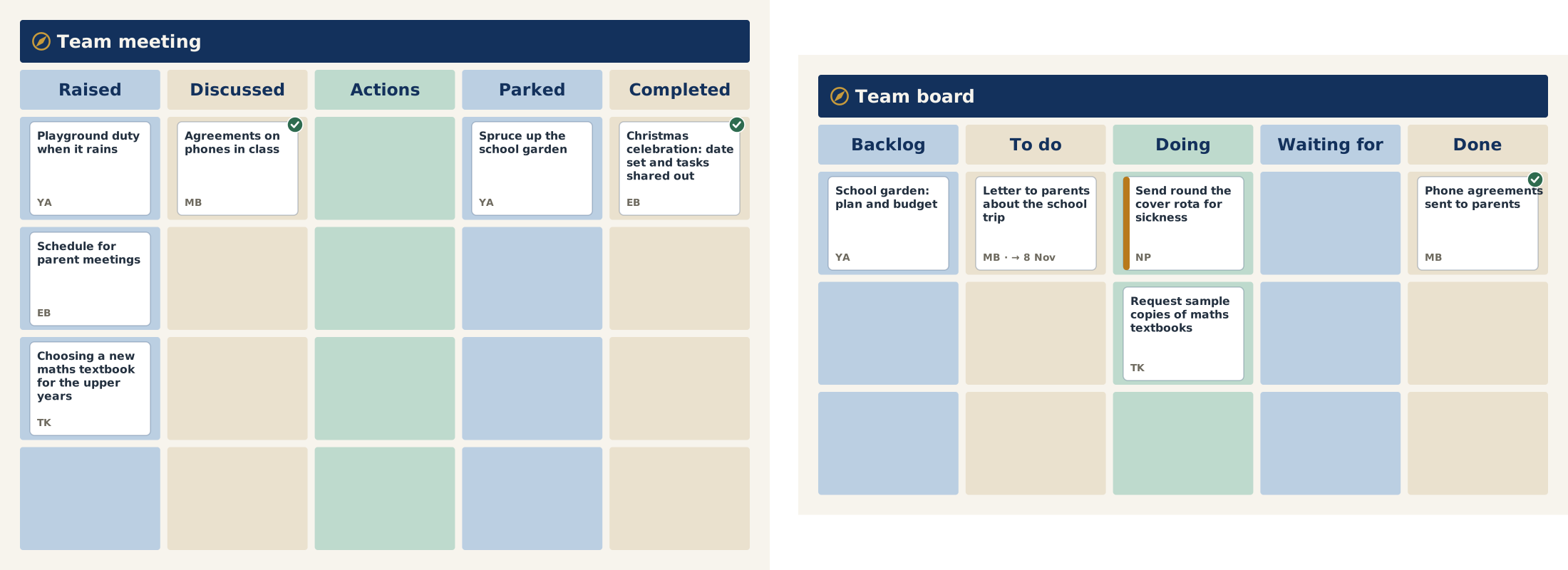
In the meeting, you first check whether the decisions and actions from last time have been carried out. Then the topics, one by one. Every topic ends in a decision, an action or next time. A decision goes in the decision list. An action goes on the work board, or in the Actions column if you have no work board. With next time, the card stays in Raised.
You meet every week (or every two weeks).
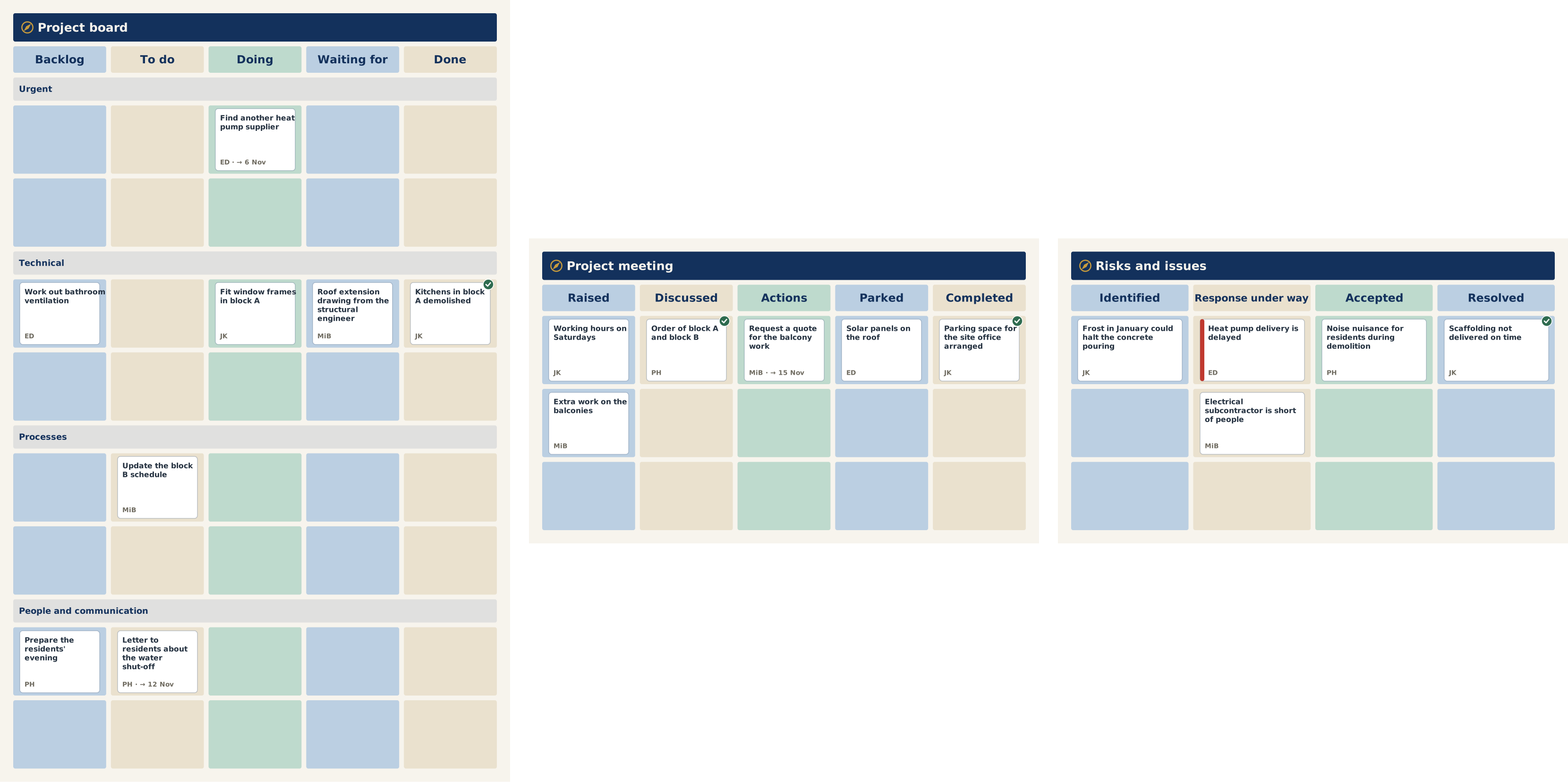
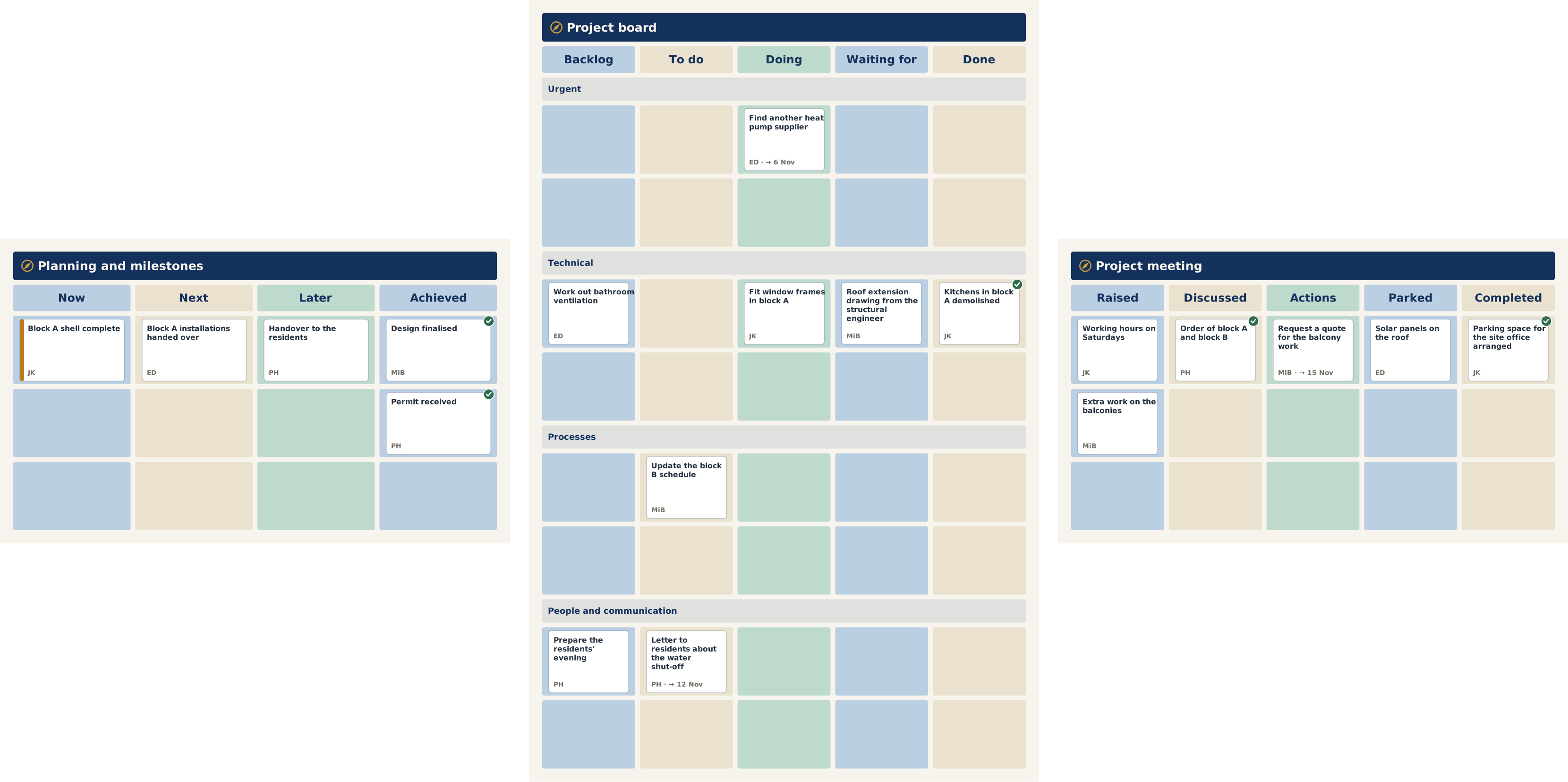
Together with other boards

Questions about team meetings
What do you discuss in a team meeting?
What has happened with the agreements since last time, what is stuck now and what the team picks up next. What everyone has done this week does not belong in it. That is on the board.
What does a good team meeting agenda look like?
Short and the same every time: a short check-in, the decisions and actions from last time, the topics the team has raised, and a wrap-up. On a Kanban board for the meeting, the board is the agenda: whatever someone raises is on it automatically.
How long should a team meeting take?
As short as possible. The longer the meeting, the less sticks. Agree an end time and stick to it. Whatever does not fit goes to next time.
How often should you hold a team meeting?
Most teams meet once a week or once every two weeks. More important than how often is that the meeting is at the same time every time.
How do you make sure agreements from the team meeting are carried out?
Every agreement gets a name and a date. Start the next meeting by asking whether it has been done. People who know that question is coming are more likely to do it.
How do you make a team meeting more effective?
Ask someone to prepare the meeting and keep the conversation on track. Start with what is stuck, not with a round of everyone. And make sure every topic ends in a decision, an action or next time.
What is the difference between a team meeting and a deep dive?
A team meeting is the regular meeting about the work: what is stuck, what needs deciding and who does what. A deep dive is about one topic or one piece of work, in depth. Agree in the team what you mean by each, so everyone knows what to expect.
How often should a care team hold a team meeting?
There is no fixed rule. A care team works in shifts, so not everyone is at every meeting. Choose a fixed time that fits the rota, every week or every two weeks, and make sure anyone who was not there can read the report and the decisions afterwards. For what comes up every day, a short daily stand-up works better than a longer team meeting.
What goes in the minutes of a team meeting?
The decisions, the actions with a name and a date, and what goes to next time. Note who was there. Who said what does not need to be in it: the minutes are there to find agreements again. The sooner the team has the report, the better.
Other ways of working
Start Monday knowing why your work matters.
You pay per board, not per person: € 50 a month for 1 board, € 90 for 2 and € 120 for 3, excluding VAT. You pay online and can start right away.