Daily stand-up: a short meeting at the board every working day
The team's work at a glance, from what is waiting to what is done.
Does this sound familiar?
What is a daily stand-up?
A daily stand-up is a short meeting at the start of the working day. The team stands at the board and looks at today together: what needs to happen, what is stuck and who picks up what. Then everyone gets on with their work.
The point is not to bring each other up to date. The point is that problems get an owner the same day, rather than at the end of the week. A colleague who gets stuck does not have to wait for the weekly meeting. Anyone with time to spare can see straight away where to help.
Which teams benefit from a daily stand-up?
Any team whose work shifts from day to day. A customer service team with new reports every morning. A hospital ward where staffing and care needs change every day. An accounting firm in the weeks before a tax deadline. A construction team that needs to agree who is working where.
If a team works on longer pieces of work that change little from one day to the next, a daily stand-up is often too much. A weekly meeting at the same board is then enough. You can also hold the stand-up only during busy periods.
Daily stand-up, huddle or morning meeting?
A daily stand-up goes by several names. Teams that work in an agile way or use Scrum call it a stand-up or daily scrum. In healthcare it is often called a huddle. Other teams simply call it the morning meeting. The idea is the same: a short daily get-together, standing up, to look at what needs attention today. It is also one of the standard routines in lean.
How they differ
In Scrum, the stand-up belongs to a sprint: the team looks at the work for that sprint. A huddle in healthcare is often about today's care: staffing, and the patients or clients who need extra attention. A daily stand-up in the broader sense is about the team's work, whatever that is.
What they have in common matters more. They are short, they follow the same format every day, and they are about what needs to happen now. Not about what everyone did yesterday.
How it works in Midflyt
In Midflyt, the daily stand-up is a daily meeting with a fixed agenda, part of the Work way of working. There are no sprints. The work is on a Kanban board, with a limit on the number of cards in Doing.
What do you discuss in a daily stand-up?
A good stand-up follows the same format every day. That way everyone knows what is coming, and it takes no longer than it needs to.
1. A short check-in
Who is in, who is not, and is there anything everyone needs to know for today? A colleague off sick, a client coming in, a system that is down. One sentence per point.
2. What needs attention
Start with anything stuck, overdue, showing no recent progress or unassigned. That is what the stand-up is for. On a Kanban board you see it at once: a card with a date that has passed, a card that has sat in the same column for days, a card without a name.
For each point, the question is: what is needed, and who will sort it out today? You do not solve it during the stand-up. You agree who will pick it up and with whom.
3. What we pick up today
Look at the column with work that is ready to start. Who is finishing something today, and who is starting something new? Only start new work when there is room in Doing.
4. Wrap up
Briefly repeat what was agreed: who does what. Then the stand-up is over.
What does not belong in it
A round in which everyone says what they did yesterday. That is on the board. In-depth discussions about a single task do not belong in it either: they continue after the stand-up, with only the people who need to be involved.
What does a good stand-up board look like?
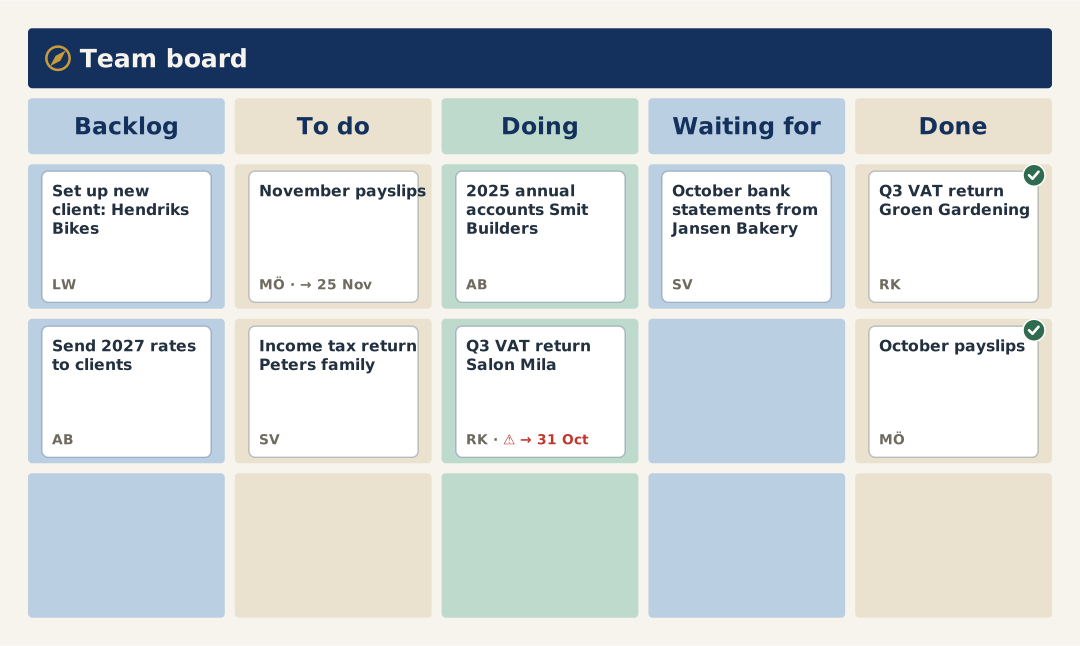
A stand-up board shows the team's work, with the name of whoever is doing each card. Start simple: what is waiting (Backlog), what is ready to start (To do), what someone is working on (Doing), what is waiting on someone else (Waiting for) and what is finished (Done).
An example: an accounting firm
Take the team at an accounting firm in November. In Doing are the annual accounts for a building firm and the VAT return for a hair salon. In To do are the November payslips, with the date they need to be ready. In Waiting for are the bank statements a client still has to send. The VAT return should have been finished at the end of October: the date shows in red. That card is what today's stand-up is about.
A limit for Doing
Agree how many cards can be in Doing at the same time. Then you see straight away when the team is taking on too much at once. If Doing is full, the team finishes something before anything new is added. That is often the most useful conversation of the week: what do we finish first?
Only put on it what you can discuss
A stand-up board full of cards that have not moved for weeks makes the stand-up long and dull. Remove whatever is no longer relevant. Work that will not start for months does not need to be on today's board.
Stand-up boards: examples from healthcare, offices and construction
A stand-up board looks different in every sector. What stays the same: every card is a piece of work with a name on it, and whatever is stuck stands out.
A stand-up board in healthcare
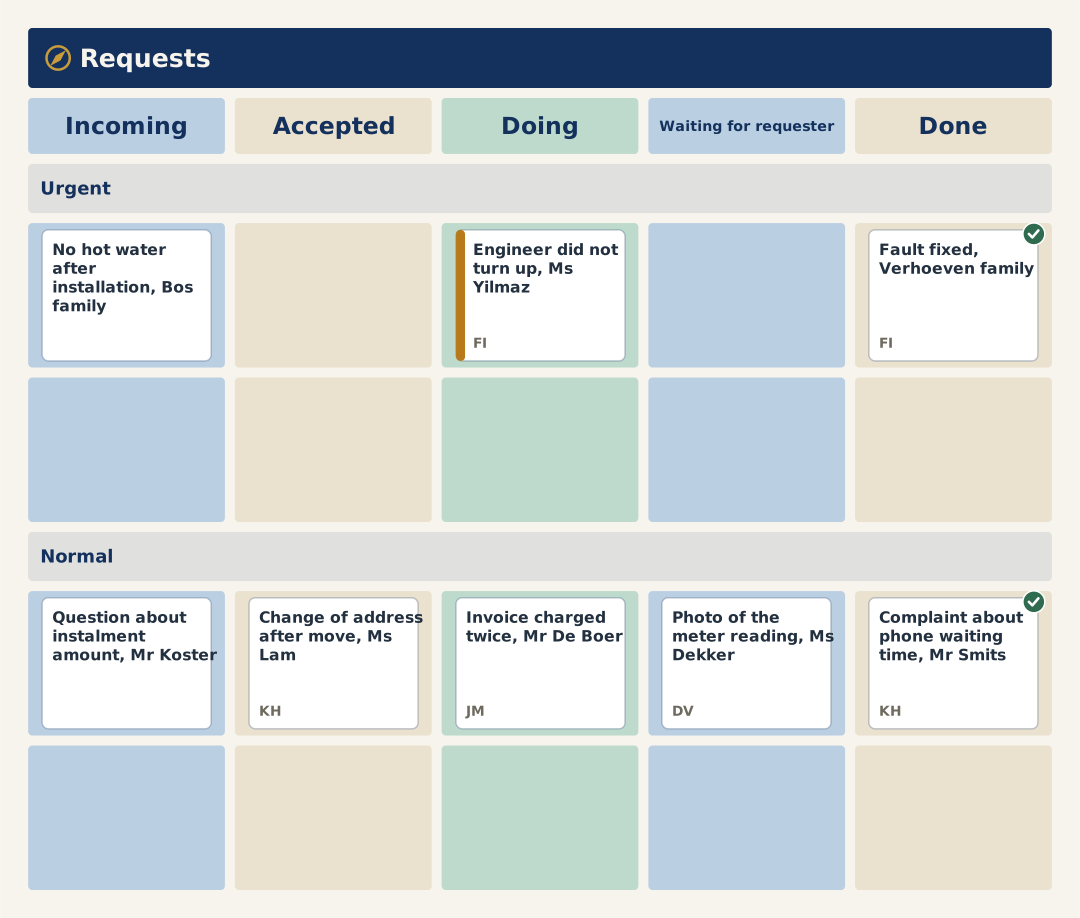
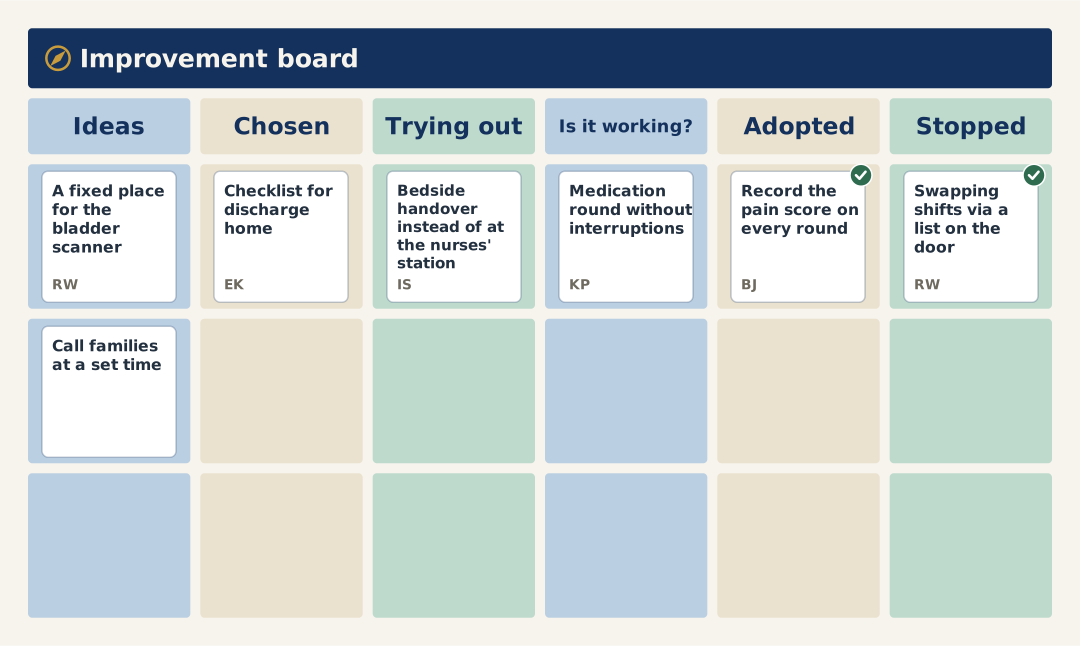
On a hospital ward, Doing holds the admission of a new patient and a conversation with a family. Waiting for holds a lab result and a medicine the pharmacy still has to deliver. To do holds a discharge home, with a checklist that is not yet complete. Today's stand-up is about the pharmacy: that delivery should have arrived yesterday. At a GP practice, the same board holds the call-back requests, the repeat prescriptions waiting for a signature and today's home visits.
A stand-up board in an office
In the permits team at a municipality, Doing holds the assessment of an application for a dormer window and an application for an event. Waiting for holds a drawing an applicant still has to send, and advice from another department. The event application shows its date in red: the deadline is nearly up. That is where the stand-up starts.
A stand-up board in construction
On a building site, or in the workshop of an installation company, the work is shown per crew or per project. Doing holds the pipework in block B and finishing the meter cupboards. Waiting for holds the scaffolding at the back, which has not yet been signed off. To do holds the handover of the first homes. The stand-up is about the scaffolding: without it, the crew cannot carry on tomorrow.
In education and childcare
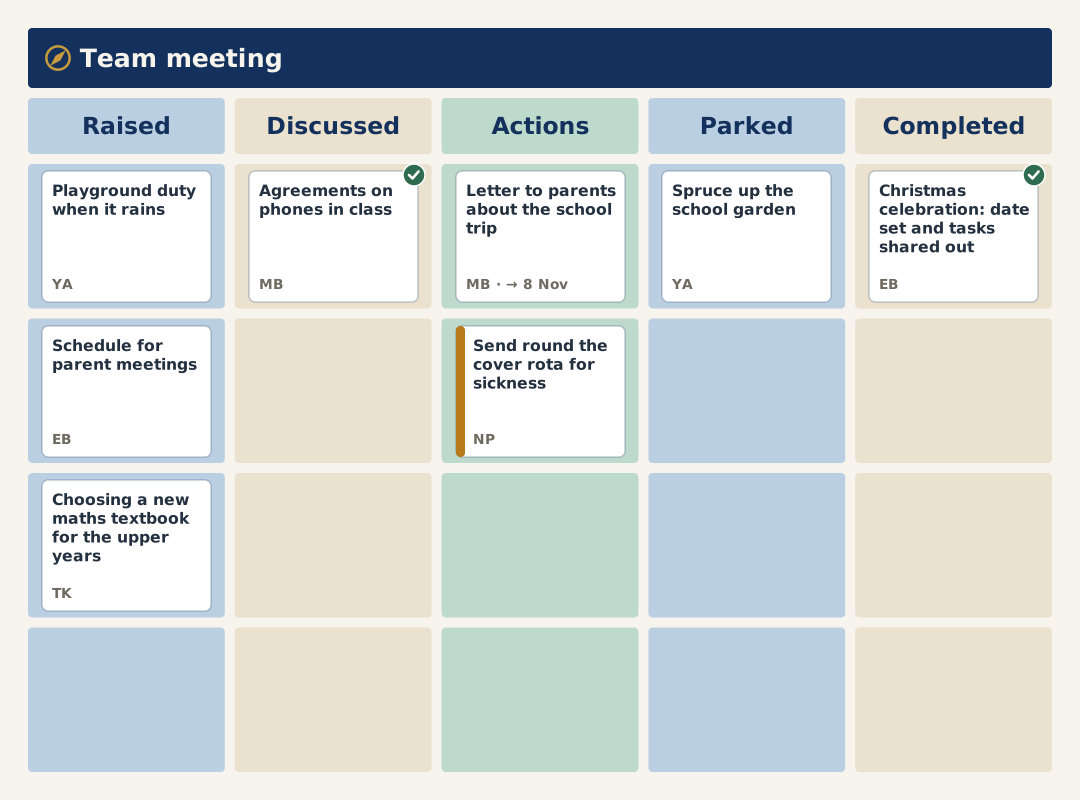
A school team or a childcare team holds the stand-up before the children arrive. The board shows who is covering today, which parent has asked for a meeting and what still needs to be done for this week's activity.
How long does a daily stand-up take?
A daily stand-up is short: fifteen minutes is enough for most teams. Standing helps. People who sit down talk for longer.
How to keep it short
- Start on time, even if someone is missing.
- Start with what is stuck, not with a round of everyone.
- Put a topic that needs more time on a card and agree who will pick it up after the stand-up.
- Ask one person to keep the conversation on track: is anyone talking at length about something that does not concern everyone?
If the stand-up keeps running over, look at the board. Often there is too much on it, or too much in Doing at once.
Weekly kick-off: the same thing, once a week
Not every team needs a stand-up every day. If the team works on tasks that do not shift from day to day, a weekly kick-off is often enough. It has the same format, once a week, at the start of the week.
What do you discuss in a weekly kick-off?
- Check-in: who is in this week, who is not, and what does everyone need to know?
- What needs attention: anything stuck, overdue, showing no recent progress or unassigned.
- The board from right to left: first what is nearly finished, then what is in progress, and only at the end what is new.
- What we pick up this week: who is finishing what, and who is starting something new?
- Wrap up: who does what, out loud.
A weekly kick-off board
A weekly kick-off board is the same board as a stand-up board. Only the meeting schedule is different. Look back first: what is finished, what has been left? Then look ahead, but do not put the whole month on the board. Only what is happening this week and what is stuck.
A daily stand-up and a weekly kick-off together
A team can also do both: a weekly kick-off to look at the week as a whole, and a short daily stand-up for whatever shifts from day to day. In Midflyt, the Work way of working has a weekly meeting, every week or every two weeks, and a daily stand-up that you switch on when you create the board. The team chooses the day and time.
Common mistakes with a daily stand-up
It turns into a status round
Everyone takes it in turns to say what they are going to do. It takes a long time and nobody listens, because it is always about someone else. Turn it around: start with the board and with what needs attention.
No agreements come out of it
The stand-up is pleasant, but afterwards nobody knows who was going to pick up what. End every point with a name. Put that name on the card.
Problems surface too late
People who are stuck do not say so, or wait for the weekly meeting. Make it easy: a card that shows no recent progress or is overdue comes up automatically. Then nobody has to raise their hand.
The stand-up carries on, even when it no longer helps
A stand-up that only continues out of habit costs time every day. Once a month, ask the team: is this still useful, and what should change? Sometimes a different format, or meeting less often, works better.
Keeping the daily stand-up useful
A stand-up works when the board is up to date. Whoever picks something up moves the card. Whoever finishes something moves it to Done. Then nobody has to ask during the stand-up how things are going.
Take turns leading the stand-up. That way everyone experiences what it takes to keep the conversation short, and it does not always fall to the team leader.
Link the stand-up to a weekly meeting. In the stand-up you sort out today. In the weekly meeting you look further ahead, discuss what keeps coming back and choose what to pick up next.
How it works in Midflyt
On the board, every card is a task that someone is doing. The columns are Backlog, To do, Doing, Waiting for and Done.
The stand-up goes like this: Check-in, What needs attention, What we pick up today and Wrap up. What needs attention lists anything stuck, overdue, showing no recent progress or unassigned.
Alongside the weekly meeting, the Work way of working has a daily stand-up: every working day, short and standing up. You switch it on when you create the board.
Questions about the daily stand-up
What is a daily stand-up?
A short meeting at the start of the working day, standing at the board. The team looks at what needs to happen today, what is stuck and who picks up what.
What do you discuss in a daily stand-up?
What needs attention today, what was left yesterday and who needs help. Not stories about what everyone has done.
How long does a daily stand-up take?
Not long: usually ten to fifteen minutes, standing up. People who sit down talk for longer.
What goes on a stand-up board?
Today's work and whatever is stuck, with the name of whoever is doing each card. Nothing more. A stand-up board that is too full makes the stand-up long.
What do you do with topics that need more time?
You agree who will pick it up after the stand-up, and with whom. The topic gets a card. That keeps the stand-up short and the topic does not get lost.
What are common mistakes with a daily stand-up?
Too long, too many stories and no agreements. And a stand-up that carries on while nobody knows what it is for. If the team no longer gets anything out of the stand-up, the format needs to change.
What do you discuss in a weekly kick-off?
What needs to happen this week, what is stuck and who picks up what. Start with a short check-in: who is in this week, and what does everyone need to know? Then discuss what needs attention first, go through the board from what is nearly finished to what is new, and wrap up with who does what.
What is the difference between a daily stand-up and a daily scrum?
There is little difference. Daily scrum is the name used by teams that work with Scrum, where it belongs to a sprint. A daily stand-up is about the team's work, whatever that is. Both are short, held standing up and every working day. In Midflyt, the daily stand-up is the daily meeting of the Work way of working, without sprints.
Other ways of working
Start Monday knowing why your work matters.
You pay per board, not per person: € 50 a month for 1 board, € 90 for 2 and € 120 for 3, excluding VAT. You pay online and can start right away.