Annual plan and team goals on one board
What you want to achieve and when, with the work behind it on the work board.
Does this sound familiar?
Making an annual plan for your team
An annual plan for a team does not have to be a thick document. It needs to answer one question: what do we want to achieve this year, and when does it need to be done? Anything that does not contribute to that does not belong in it.
Start with what you want to achieve
Not with everything that needs to happen. A list of activities is not a plan. Ask the team: if this year goes well, what will be different at the end of it? That is where the goals come from.
Choose a few goals
A team can remember three to five goals and discuss them every month. With more goals, each goal matters less, and nobody knows any more what comes first.
Put every goal in a period
By quarter, or as Now, Next and Later. A goal without a date keeps getting pushed back. A goal that has to be finished in the second quarter needs work in the first quarter.
Link the work to it
Every goal comes with work: the tasks needed to achieve it. Those are on the team's work board. That way you can see whether the everyday work contributes to what you want to achieve.
An A3 annual plan on one board
An A3 annual plan is an annual plan on a single sheet of A3. That one sheet holds everything: where the team stands, what it wants to achieve this year, the goals, what is needed and how you will know it is working. The idea is that whatever fits on one sheet actually gets read. Nobody reads a thick plan.
What goes on an A3 annual plan
- What the team is there for, in a few sentences.
- Where the team stands now: what went well, what did not, and what is changing.
- The goals: three to five, each with a date.
- What is needed: the most important work for each goal.
- How you will know it is working: for each goal, what will tell you.
From sheet to board
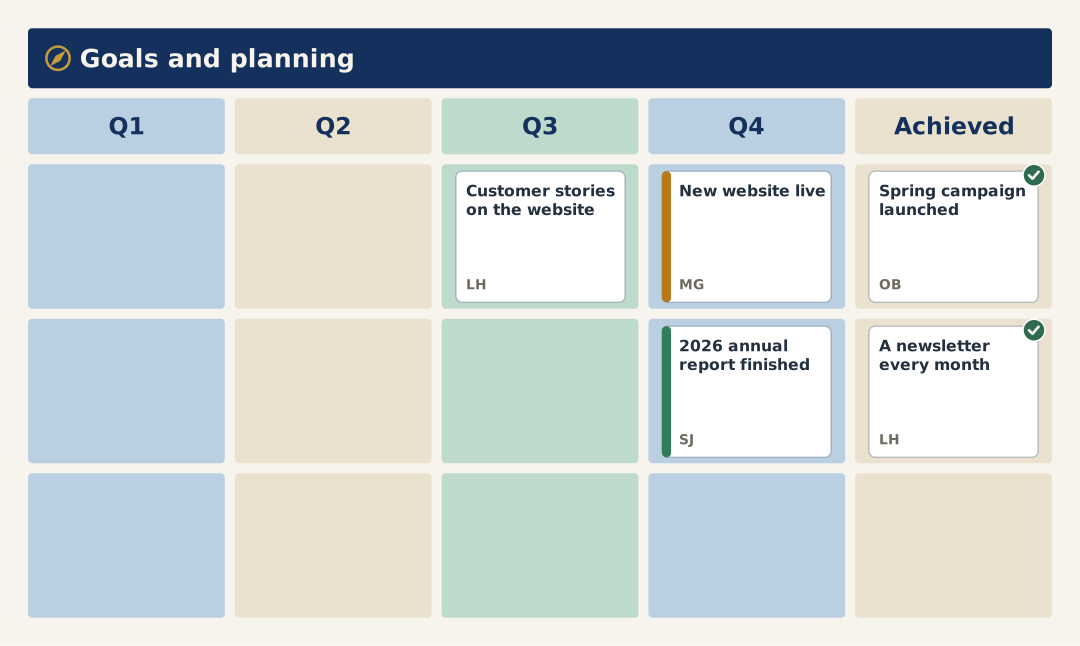
An A3 on the wall slips out of sight after a few weeks. Nobody looks at it any more, because nothing on it changes. On a board, the plan keeps moving. The goals are in their period, the colour shows how each one is doing, and the work underneath moves along. It is still an A3: everything in one place, at a glance. But one that is up to date every month.
If you also want the direction for each theme, the metrics and the monthly steps on one board alongside the goals, that is an Obeya.
Annual plan examples: healthcare, education and local government
What does an annual plan look like? Three examples, each with a few goals in their period. The work underneath is on the team's work board.
An annual plan in healthcare
The team on a ward in a nursing home, with its goals by quarter.
| Quarter | Goal |
|---|---|
| Q1 | Every new resident has a care plan within their first week. |
| Q2 | Bedside handover on all shifts. |
| Q3 | Induction programme for new colleagues finished and in use. |
| Q4 | Falls discussed every month at the team meeting. |
An annual plan in education
The team at a primary school, translating the school improvement plan for its own team. A school year does not line up with the quarters, so this team works with Now, Next and Later.
| Period | Goal |
|---|---|
| Now | New approach to reading comprehension started in all classes. |
| Now | One way of handing over between classes. |
| Next | After the first meeting, parents know what their child will learn this year. |
| Later | Results discussed for each class, with a plan for each class. |
An annual plan at a municipality
The permits team, with its goals by quarter.
| Quarter | Goal |
|---|---|
| Q1 | Every application gets a decision within the statutory deadline. |
| Q2 | Applicants know at every step where their application stands. |
| Q3 | Clear agreements with Enforcement about what happens after a permit is issued. |
| Q4 | One work instruction per type of permit, for new colleagues. |
Each of these goals says what will be different, with a date attached. The work hangs underneath, and every month the team checks whether that work is moving.
Setting team goals: examples, including from healthcare
A good team goal says what will be different once it is achieved, with a date attached. The team can achieve it itself, and everyone can see whether it has worked.
Examples from a marketing and communications team
- New website live, in the fourth quarter.
- A newsletter every month.
- Customer satisfaction measured and shared.
- House style in all standard documents.
- 2026 annual report finished.
Each of these goals says what there will be. "Do more on customer satisfaction" does not. "Customer satisfaction measured and shared" does: at the end, you know whether it happened.
Examples from a care team
- Every client has a named contact in the team, in the first quarter.
- Rota requests known a month in advance.
- A fixed place and a fixed list for the handover.
- Every new colleague inducted with a buddy.
- Family meetings planned within a week of admission.
Here too, each goal says what there will be. "Better communication with families" does not. "Family meetings planned within a week of admission" does.
From organisational goals to team goals
Ask what your team contributes to what the organisation wants to achieve. An organisational goal such as "more satisfied customers" becomes something like "every report resolved within a week" for a customer service team, and "customer satisfaction measured and shared" for a marketing team. The team goal is something the team has in its own hands.
An annual plan on one board
Many teams want their annual plan on a single sheet of A4. That is a good idea: what fits on one page actually gets read. A board is the living version of that. The goals are in their period, and the colour of each card shows how it is doing: on track, needs attention or behind.
Quarters, or Now, Next and Later
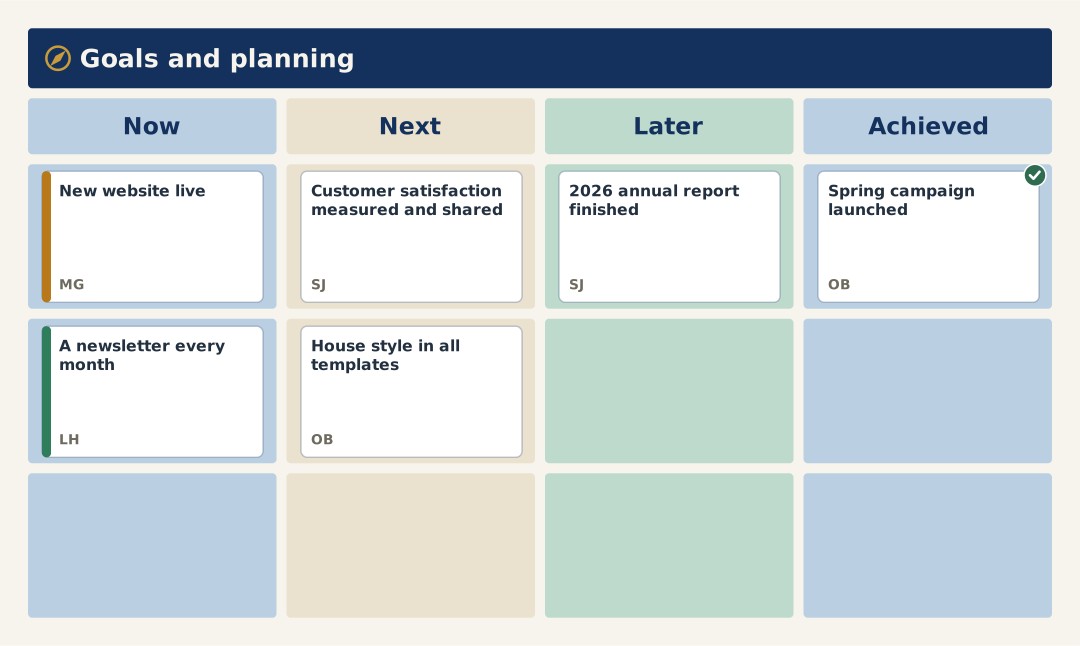
With quarters you see when something needs to be finished. If a goal is still in a quarter that has passed, it needs attention. With Now, Next and Later you deliberately choose what comes first now. That works well for teams that are not tied to fixed dates in the year, or whose priorities often shift.
The goal does not move through the columns the way work does on a work board. It stays in its period, and the work underneath moves.
From department plan to team plan
Most teams do not set their goals out of nowhere. There is a department plan, and above that often an organisational plan. The department plan says what the department wants to achieve. The team plan says what the team contributes to that.
How to turn a department plan into a team plan
- Read the department plan together. Which goals affect your work? Not every goal concerns every team.
- Ask what you contribute. The same department goal means something different for one team than for another.
- Turn it into team goals. Something the team can achieve itself, with a date attached.
- Link the work to it. On the team's work board.
- Show what you made of it. Show the department which team goals came out of its plan. Then it becomes clear early on whether anything is missing or duplicated.
An example: a department plan at a municipality
A municipality's department plan says: residents and businesses get clarity about their application sooner. The permits team turns that into team goals like those in the example above. The customer contact centre turns it into something else: every question about an application answered straight away, without transferring the call. The same department goal, two team plans.
If the whole organisation works with goals that run from the executive team to the team, an Obeya is the next step. Read more about from strategy to execution.
Tracking progress on your team goals
An annual plan that is only opened in January and December helps nobody. It only becomes clear at the end of the year that a goal will not be achieved, when nothing can be done about it any more.
Every month, goal by goal
Every month, discuss each goal: is it on track, and why or why not? Also check whether the work behind it is moving. A goal with no work underneath will not be achieved. A goal whose work has shown no progress for weeks needs attention, even if its colour is still green.
Choose again every quarter
Every quarter, look further ahead: what have we achieved, what comes first now, and what do we stop doing? New plans keep being added. Without a moment to stop, after six months there is too much on the plan at once and everything is a priority.
Common mistakes with an annual plan
- Too many goals. Nobody can name them, so nobody works on them.
- Goals without a date. They keep getting pushed back all year.
- No work under the goal. The goal looks good, but nobody does anything for it.
- Only checking at the end. By then it is too late to change course.
- Never stopping. All sorts of things are added, and nothing is taken off.
How it works in Midflyt
On this board, every card is a goal, a result or something that must be finished within a period or phase. The columns are Now, Next, Later and Achieved. If you choose Quarters when you create the board, they are Q1, Q2, Q3, Q4 and Achieved.
The colour of the card shows whether a goal is on track, needs attention or is behind. The card does not move through the columns. You link a goal to the cards on the work board. If the work behind it shows no progress, or a card is still in a quarter that has passed, it appears under What needs attention.
You meet every month, with a meeting every quarter to choose again what goes in Now.
Questions about annual plans and team goals
How do you make an annual plan for your team?
Start with what you want to achieve this year, not with what needs to happen. Choose a few goals, put them in the period in which they must be finished, and link the work to them. Check every month whether it is on track.
How many goals should a team set for a year?
Few. A team can remember and discuss three to five goals. With more goals, each goal matters less.
How do you translate the organisation's goals into team goals?
Ask what your team contributes to what the organisation wants to achieve. A team goal is something the team can achieve itself, with a name and a date attached.
How do you track progress on your team goals?
Every month, discuss for each goal whether it is on track and why. Also check whether the work behind it is moving. A goal with no work underneath will not be achieved.
How often should you review the annual plan?
Every quarter. Then you choose again what comes first now and what you stop doing.
What makes a good team goal?
A goal that says what will be different once it is achieved, with a date attached. 'Every application dealt with within eight weeks by 1 July' works better than 'work faster'.
What is an A3 annual plan?
An annual plan on a single sheet of A3. It shows where the team stands, what it wants to achieve, the goals with a date, what is needed and how you will see whether it is working. Because it fits on one sheet, it actually gets read. On a board, a plan like that stays up to date every month.
What does an annual plan look like?
Short. A few goals, each in the period in which it must be finished, with the work underneath. An annual plan for a team fits on one sheet of A4 or A3, or on one board. A plan nobody opens because it is too long does not help.
Other ways of working
Start Monday knowing why your work matters.
You pay per board, not per person: € 50 a month for 1 board, € 90 for 2 and € 120 for 3, excluding VAT. You pay online and can start right away.